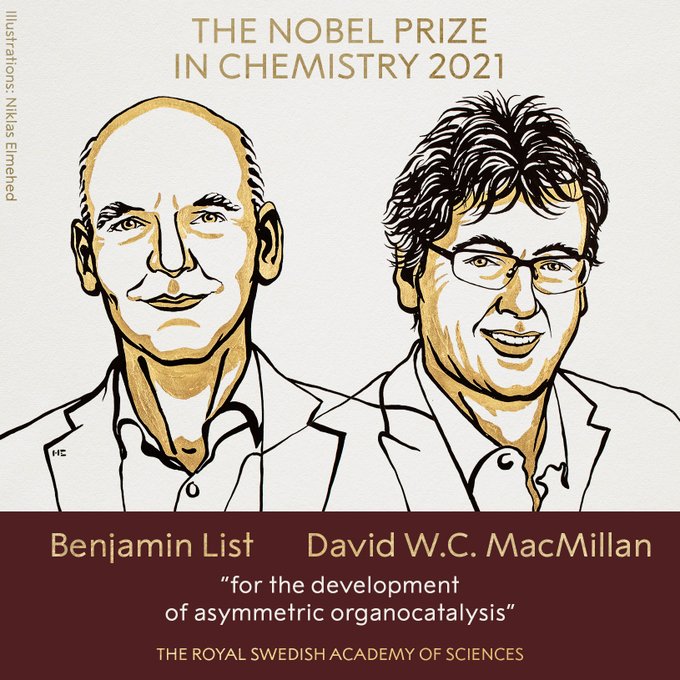
Benjamin List and David WC MacMillan won the 2021 Nobel Prize in Chemistry for the development of asymmetric organocatalysis. The duo developed a precise new tool for molecular construction, which had a great impact on pharmaceutical research, and has made chemistry greener. The Nobel Prize in Chemistry is awarded by the Royal Swedish Academy of Sciences, Stockholm, Sweden.
Catalysts are fundamental tools for chemists, but researchers long believed that there were, in principle, just two types of catalysts available: metals and enzymes. The Academy said that Benjamin List, professor at the Max Plack Institute in Germany, and David MacMillan, who is currently with Princeton University, in 2000, independent of each other, developed a third type of catalysis. It is called asymmetric organocatalysis and builds upon small organic molecules.
“This concept for catalysis is as simple as it is ingenious, and the fact is that many people have wondered why we didn’t think of it earlier,” says Johan Åqvist, who is chair of the Nobel Committee for Chemistry.
The official pages added, “The discovery – asymmetric organocatalysis – being awarded the 2021 #NobelPrize in Chemistry has taken molecular construction to an entirely new level. It has not only made chemistry greener but also made it much easier to produce asymmetric molecules,”.
“Building molecules is a difficult art. Benjamin List and David MacMillan are awarded the Nobel Prize in Chemistry 2021 for their development of a precise new tool for molecular construction: organocatalysis. This has had a great impact on pharmaceutical research, and has made chemistry greener,” an official statement from the Nobel Prize website said.
Many research areas and industries depend on the ability of chemists to build molecules that can form elastic and durable materials, store energy in batteries or inhibit the progression of diseases, the statement read. This work requires catalysts, which are substances that control and accelerate chemical reactions, without becoming part of the final product.
For example, catalysts in cars transform toxic substances in exhaust fumes into harmless molecules. Our bodies also contain thousands of catalysts in the form of enzymes, which chisel out the molecules necessary for life, the statement explained.
Catalysts are thus fundamental tools for chemists, but researchers long believed that there were only two types of catalysts available: metals and enzymes. Benjamin List and David MacMillan have developed a third type of catalysis. It is called asymmetric organocatalysis and builds upon small organic molecules, the statement further said.